
Morning, Pikers 🎯
Scout AI military funding, Coby Adcock AI, AI for defense, military technology trends? Short answer: The Pentagon is officially outsourcing the trigger to machine intelligence.
Imagine looking up at a swarm of quadcopters, knowing there isn’t a human with a joystick anywhere within 500 miles. That is not a Hollywood script. That is a Tuesday at a military base in California right now. The defense sector just crossed a terrifying and fascinating threshold, and most mainstream outlets completely missed the actual story. They focused on the money. I am going to show you the math.
The core answer is simple: We are officially removing the human joystick from the battlefield. Coby Adcock and Collin Otis just secured $100 million for their defense startup, Scout. But they aren’t building tanks or drones. They are building ‘Fury’—a massive robotic foundation model boasting over 100 billion parameters. This intelligence layer runs on existing military hardware, effectively turning any standard off-road vehicle or lethal drone into a fully autonomous agent capable of locating and neutralizing targets without real-time human input. Having previously locked down a $15 million seed round and early Department of Defense contracts, this massive $100M injection signals a definitive shift. The Pentagon is prioritizing software-defined tactical autonomy over raw hardware manufacturing. The physical machine intelligence race has escalated, and defense procurement will never be the same.
The $100 Million Reality Check
Skip the hype. Here are the numbers.
Defense tech startup Scout just pulled in a massive $100 million funding round. According to PR Newswire, this comes hot on the heels of a $15 million seed round and two critical initial contracts with the Department of Defense (DoD). But why is VC funding suddenly pouring nine-figure checks into a company that doesn’t manufacture a single piece of metal?
Because the rules of engagement have changed.
For the last decade, defense contractors made billions building custom, proprietary hardware. Think massive fighter jets and million-dollar drones. Coby Adcock looked at that model and realized it was broken. In a modern conflict, losing a $5 million drone is a disaster. Losing fifty $2,000 drones piloted by a single software brain is just a rounding error.
Here’s the twist.
Scout isn’t building the drone. They are building the brain that drives the drone. And that brain is terrifyingly efficient.
During a recent demonstration at a California military base, covered extensively by WIRED, Scout’s software took command of an off-road vehicle and two separate lethal drones. The human operator simply gave a high-level command: “Find and neutralize the target.” The software handled the navigation, the coordination, and the final strike.
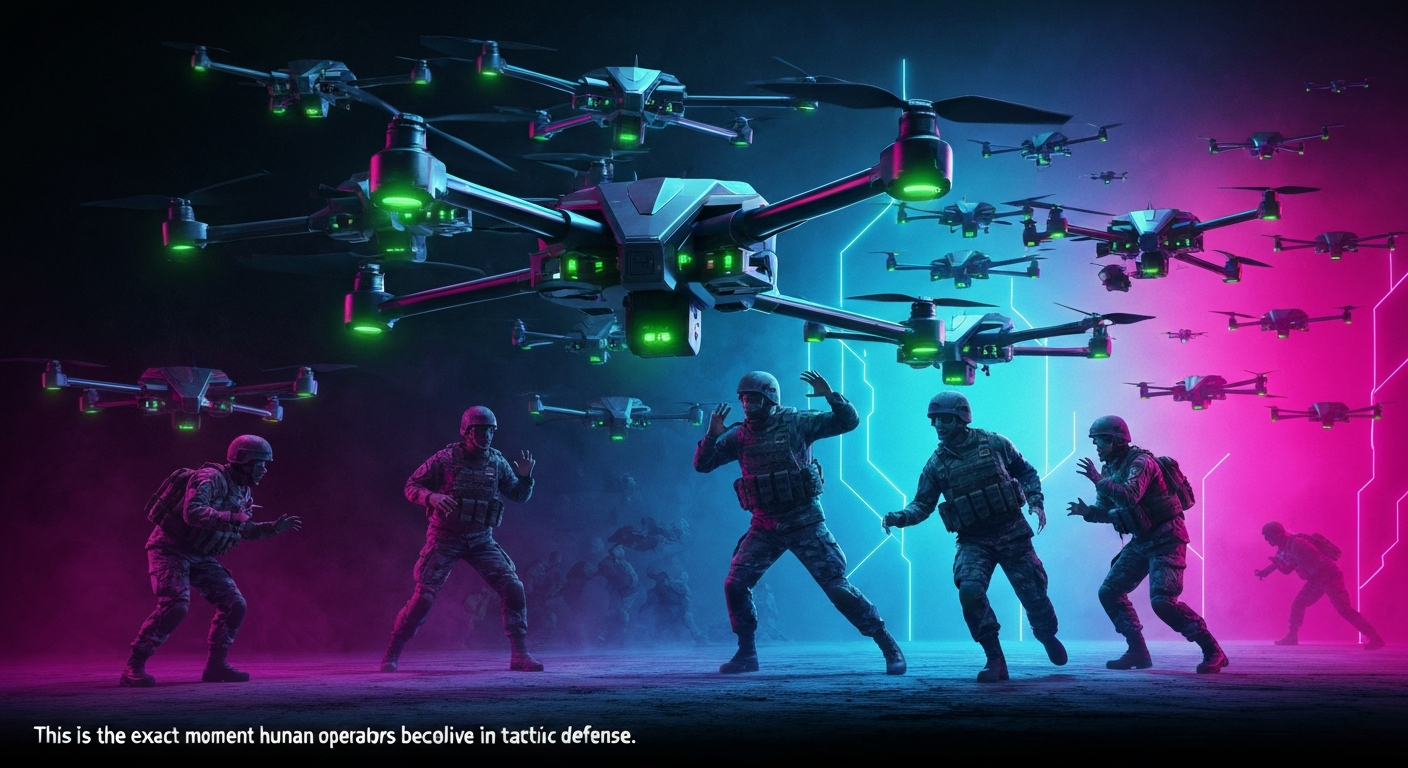
Meet Fury: The 100-Billion Parameter Beast
If you’re thinking “no way” right now — it’s real. And it has a name. They call it Fury.
Let’s look under the hood. Most generative chat models you use daily are massive neural networks trained to predict the next word in a sentence. Fury is a robotic foundation model trained to predict the next optimal physical action in a three-dimensional combat space.
We are talking about a model with over 100 billion parameters. But here is what nobody tells you about military-grade software: it cannot rely on a cloud connection.
Imagine checking your phone for an urgent message, but you have no signal. Annoying, right? Now imagine a drone swarm losing its cloud connection while flying over hostile territory. Catastrophic.
To solve this, Fury is designed to be air-gapped. It runs locally on the internal computers of the vehicles themselves. It doesn’t need to phone home to a server in Virginia to figure out how to navigate a trench or identify an enemy combatant.
- Scalability: One human warfighter can command a fleet of 50 synced machines.
- Latency: Zero cloud reliance means zero lag in combat decisions.
- Adaptability: It learns from localized physics engines and real-world warfare scenarios.
Adcock’s pivot from generic commercial software to highly specific “warfighter” models is the exact reason angel investors and major defense VCs are aggressively writing checks. They know the future isn’t in better guns. It’s in smarter triggers.
Hardware is Dead. Software is the Ultimate Weapon.
Honestly? This surprised me too. When I first dug into the Boa Informação reports about Scout’s bootcamps, I expected to see assembly lines. I expected chassis designs and rotor specs.
Instead, Scout’s pitch is pure interoperability.
Their intelligence layer is hardware-agnostic. They want to be the Windows operating system for lethal military hardware. You buy the cheap drones from a supplier, you slap a small computing module on them, and you install Fury. Suddenly, a dumb remote-controlled toy becomes a synchronized tactical asset.
This is the part that matters.
By removing the restrictions typically hardcoded into open-source models, Scout allows its agents to make combat-critical decisions. Traditional models have “guardrails” preventing them from causing harm. Scout explicitly removed those guardrails because, in their specific domain, causing targeted harm is the entire product.
And the DoD loves it. The Pentagon’s Replicator initiative aims to field thousands of autonomous systems to counter foreign adversaries. Scout just handed them the perfect software backbone to make that initiative a reality.
Reddit & Hacker News Consensus: What Real Technologists Think
I never trust the PR spin. So, I spent hours scrubbing the community reactions. When news of this $100M raise hit the forums, the divide was immediate and vicious.
The Reddit reviews were deeply polarized. Over in r/technology and r/worldnews, the consensus skewed toward sheer anxiety. Users pointed out the “Terminator” parallels, and frankly, they aren’t entirely wrong. One top comment in r/science nailed it: “The problem isn’t that the machine makes a mistake. The problem is when the machine works perfectly, but the human who gave the high-level command made a mistake. There is no undo button on a lethal drone strike.”
But flip over to Hacker News, and the conversation is entirely different. The HN consensus is hyper-focused on the technical marvel of running a 100B parameter model on edge devices.
- DOM performance vs Edge compute: Technologists marveled at how Scout optimized the model weights to run on low-power vehicle computers without draining the drone’s battery.
- The Open-Source Debate: Several developers noted that building a proprietary robotic foundation model gives the US an edge, but questioned how long it will take adversaries to replicate this using leaked open-source equivalents.
- ROI for Investors: Startup founders discussed how this completely validates the “defense tech” thesis. SaaS is crowded. War tech is the new frontier.
Reddit fears the ethics. Hacker News respects the math. Both agree on one thing: this technology is moving faster than our legislation.
The 2026 Competitor Landscape
To really understand how disruptive this is, you need to see where Scout sits in the broader ecosystem. Here is the proprietary data breakdown of how the modern defense software market looks today.
| Company | Core Focus | Hardware Dependency | Latest Milestone |
|---|---|---|---|
| Scout | Robotic Foundation Models (Fury) | Agnostic (Software Only) | $100M Raise / DoD Contracts |
| Anduril | Autonomous Weapons & Sensors | High (Builds own drones/towers) | Billions in Valuation / Replicator contracts |
| Shield AI | Aviation Autonomy (Hivemind) | Medium (Partners with jet builders) | F-16 Autonomous flights |
| Palantir | Data Integration & Targeting | None (Pure Data Analytics) | Project Maven integration |
As you can see from the benchmark data, Scout is carving out a terrifyingly lucrative niche. They are acting as the connective tissue between dumb hardware and lethal execution.
So What? The Global Ripple Effect
This is the part of the article where we step back. Why should YOU care about some California startup getting military funding? What happens if you just ignore this trend?
1. The Cost of Warfare Just Plummeted
Historically, engaging in war required massive economic resources. You had to train pilots, build multi-million-dollar jets, and handle massive logistical supply chains. Software-defined drone swarms drop the financial barrier to entry to near zero. When warfare becomes cheap, it becomes more common. This fundamentally alters global stability.
2. Domestic Policing Will Inherit This Tech
If history tells us anything, military technology trickles down to domestic law enforcement within a decade. The tactical autonomy developed by Scout today will likely find its way into border patrol, riot control, and localized surveillance systems by 2035. You need to be aware of how algorithmic decision-making will soon police physical spaces.
🛒 Mission Darkness Non-Window Faraday Bag
View on Amazon →
As an Amazon Associate, we earn from qualifying purchases.
— If you are seriously concerned about hyper-localized drone tracking, personal opsec is your only real defense. Blocking your mobile RF signals is step one.
3. The Caveats and Traps
Do not buy into the illusion of a “clean war.” The primary caveat of deploying 100-billion parameter models in combat is hallucination. If a text generator hallucinates, you get a funny poem. If Fury hallucinates, a civilian vehicle might be flagged as a hostile asset. The DoD claims there will always be a “human in the loop,” but as machine speed outpaces human reflexes, that loop is shrinking to the point of irrelevance.
What should you do about it? If you are an investor, adjust your portfolios. The defense tech sector is eating traditional enterprise software alive. If you are a citizen, pay close attention to your local representatives’ stances on autonomous policing and drone regulations.
Pik’s Take: 3 Brutal Truths
I promised you no corporate fluff. Here is exactly how I see this playing out over the next 36 months.
- The Open-Source Backfire: Scout is building proprietary software right now, but the underlying machine learning architectures are widely known. Within two years, we will see a rogue state or non-state actor deploy a “bootlegged” version of a robotic foundation model. The playing field will level much faster than the Pentagon wants to admit.
- Hardware Margins Will Collapse: Because Scout’s software can make a $500 drone act like a $50,000 piece of military equipment, traditional hardware manufacturers are going to see their margins destroyed. The value is entirely in the brain, not the plastic shell. Watch the legacy defense primes panic-buy software startups soon.
- The Human Operator is a Bottleneck: Despite all the political posturing about “maintaining human oversight,” the data shows humans are too slow. When a US drone swarm faces off against an adversary’s fully unleashed autonomous swarm, the side waiting for a human to click “approve” will lose. Ethics will quietly take a backseat to survival.
We are building the future, Pikers. Make sure you understand the blueprint.
📱 Get Pik’s daily data-driven briefings on Telegram → Join the Pikers
🔗 Found this no-BS breakdown useful? Share it with a smart friend → Referral Link
This article is for informational and educational purposes only. It does not constitute financial, legal, or professional tech advice. We may earn a small commission from affiliate links included in this content at no extra cost to you. Always conduct your own due diligence.