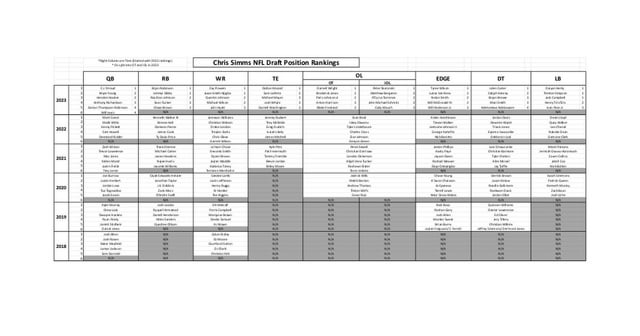
Chris Simms NFL rankings are back in the conversation — and if you follow r/nfl at all, you already know the comment sections are on fire.
Here’s the thing: most people either dismiss Simms as a troll or worship him as the last honest analyst in football media. Both camps are wrong. The truth is more useful than either take.
Imagine you’re sitting down to watch the playoffs and your buddy — the one who actually played college ball — starts telling you the guy everyone thinks is elite has a mechanical flaw that’s going to get exposed under pressure. You roll your eyes. Then it happens exactly like he said. That’s the Simms experience. Sometimes.
- Simms uses a film-first, scheme-fit methodology that prioritizes mechanical traits over win totals or Super Bowl rings.
- His biggest verified hits: Mahomes #1 in 2017, Lamar Jackson #1 and Josh Allen #2 in 2018 — both before consensus caught on.
- His 2025 QB countdown placed Jalen Hurts at #10, calling him ‘the ultimate leader’ but flagging real mechanical concerns.
- Jared Goff landed in his ‘Scheme Dream’ tier — a controversial but data-supportable call given Detroit’s offensive system.
- For Super Bowl contention in 2026, Simms’ framework favors teams with schematic cohesion over raw talent accumulation.
- His notable misses — Matt Corral, Zach Wilson, Drake Maye — are real and worth factoring into how much weight you give his current calls.
- Why Chris Simms Still Matters in 2026
- The Film-First Method: How He Actually Evaluates QBs
- His 2025 QB Rankings — The Good, The Controversial, The Flat-Out Wrong
- Who Are the Real Super Bowl Contenders by His Logic?
- Simms Tiers vs. Consensus Rankings: The Data
- What Reddit and the NFL Community Actually Think
- The Miss List — Why You Can’t Ignore the Track Record
- Pik’s Take: 3 Things That Actually Matter Here
Why Chris Simms Still Matters in 2026
Let’s be straight: Simms is polarizing because he’s willing to be wrong in public. That’s rarer than it sounds in sports media, where most analysts hedge everything until a clear winner emerges and then act like they called it all along.
His credibility comes from two very specific moments. In 2017, when everyone was debating Deshaun Watson and Mitchell Trubisky in the draft, Simms put Patrick Mahomes at #1 — a call so early and so right that it’s basically become his calling card. According to a widely-cited thread on r/nfl, he also had Lamar Jackson #1 and Josh Allen #2 in 2018, before either player became the generational talent argument they are today.
That’s not luck. Two back-to-back correct takes on players most scouts buried? That’s methodology. The question for 2026 is whether that same methodology still holds when applied to active, proven starters rather than draft prospects.
Here’s the twist — those are completely different analytical problems. Evaluating a college prospect on mechanical ceiling is one thing. Ranking an established Super Bowl winner against his peers is another. Simms blends both, which is exactly why people get frustrated.
The Film-First Method: How He Actually Evaluates QBs
Before you agree or disagree with any specific ranking, you need to understand what Simms is actually measuring. He’s not looking at passer rating. He’s not looking at Super Bowl rings. He’s looking at three things in particular:
- Mechanical traits: Release point, footwork under pressure, ability to throw from different arm angles
- Scheme fit: Whether the player’s skill set maximizes the specific offensive system around him
- Decision-making speed: Pre-snap reads, post-snap processing, willingness to go through progressions rather than locking onto a first read
This is why Jared Goff ends up in a ‘Scheme Dream’ tier in his 2025 rankings, according to NBC Sports. Goff’s raw numbers and ‘fearless decision-making’ within Ben Johnson’s system make him a near-elite player in that specific context. Put him somewhere else? Different story. Simms isn’t saying Goff is the best QB in football. He’s saying Goff is maximizing what his system asks of him — and that’s a legitimate analytical distinction that most mainstream rankings don’t make.
It’s also why Jalen Hurts sits at #10 despite his NFC Championship appearances and MVP-level seasons. Simms called him ‘the ultimate leader’ but flagged real mechanical concerns — specifically around his ability to consistently dissect defenses through the air when his legs are taken away. Whether you agree or not, that’s a coherent argument rooted in film, not vibes.
His 2025 QB Rankings — The Good, The Controversial, The Flat-Out Wrong
Let’s break this down without the noise. Here’s where the main debates live:
The Defensible Calls
Placing Goff in a premium tier isn’t crazy when you look at his 2023-2024 numbers inside Detroit’s system. The Lions went from irrelevant to NFC Championship contenders on the back of that offensive cohesion. Scheme fit matters — and Simms has been saying this for years while everyone else kept writing Goff off as a one-hit wonder from his Rams years.
The Hurts placement is also more defensible than Reddit gives it credit for. When Philadelphia’s run game is neutralized — specifically in high-stakes playoff moments — Hurts has shown real limitations as a pure pocket passer. Calling him a top-10 QB while flagging that ceiling isn’t contradictory. It’s nuanced.
The Controversial Tier
Where it gets messy is when Simms ranks proven Super Bowl winners lower than quarterbacks with higher mechanical grades but thinner résumés. The community argument — and it’s a fair one — is that winning under pressure in January is its own measurable skill that pure mechanics don’t capture. His framework doesn’t have a great answer for that, and he knows it.
The Actual Misses
This is the part Simms’ fans don’t like to talk about. His historical draft evaluations include Matt Corral, Zach Wilson, and Drake Maye in favorable positions that didn’t pan out the way his analysis suggested. Per the r/nfl community thread cited above, these misses are real and worth keeping in mind before you treat his current rankings as gospel.
Honestly? Every analyst has a miss list. The question is whether the hit rate justifies the platform. For Simms, I’d argue it barely does — but it does.
Who Are the Real Super Bowl Contenders by His Logic?
Apply the Simms framework to the current NFL landscape and a few things become clear. Teams with high schematic cohesion and a QB operating near his mechanical ceiling are his preferred Super Bowl profile. That historically favors:
- Kansas City Chiefs — Mahomes remains the clearest case of mechanical excellence meeting elite offensive design
- Detroit Lions — Goff + Johnson’s system is exactly the ‘Scheme Dream’ archetype he elevates
- Buffalo Bills — Allen’s combination of arm talent and improved decision-making fits his top-tier criteria
- Philadelphia Eagles — Hurts at #10 still means top-10, and their offensive line structure remains elite
Back in 2017, Simms was already highlighting the Dallas Cowboys’ offensive line as the primary structural factor for contention — before most analysts were thinking that way. That same offensive-structure-first lens applies to how he evaluates teams today. The QB ranking is the headline, but the system around the QB is the real argument.
Wait — this is important. The implication for 2026 is that teams adding raw talent without building schematic cohesion are being overvalued by conventional power rankings. Simms would push back hard on any team that looks good on paper but has an offensive coordinator-QB communication breakdown. We’ve seen that play out in real time more than once.
Simms Tiers vs. Consensus Rankings: The Data
| QB | Simms 2025 Tier | Consensus Ranking (Approx.) | Gap | Simms’ Core Reasoning |
|---|---|---|---|---|
| Patrick Mahomes | Elite Tier (Top 2) | #1–2 | ✅ Aligned | Mechanical ceiling + scheme mastery |
| Josh Allen | Elite Tier (Top 3) | #2–3 | ✅ Aligned | Improved processing + arm talent |
| Lamar Jackson | Elite Tier | #1–3 | ✅ Broadly aligned | Unique mechanical profile, system fit |
| Jalen Hurts | #10 (‘Ultimate Leader’) | #4–6 | ⚠️ Significant gap | Mechanical ceiling concerns vs. run-first dependency |
| Jared Goff | ‘Scheme Dream’ premium | #10–14 | 🔺 Elevated by Simms | Fearless decision-making in optimal system |
| Joe Burrow | High tier (when healthy) | #4–7 | ✅ Generally aligned | Elite processing speed, health caveat |
| Year | Simms’ #1 QB Prospect | Outcome | Verdict |
|---|---|---|---|
| 2017 | Patrick Mahomes | 4x Super Bowl appearances, 3 wins, 3x MVP | ✅ Major hit |
| 2018 | Lamar Jackson #1, Josh Allen #2 | Both became top-3 QBs in the league | ✅ Major hit |
| Post-2018 | Matt Corral, Zach Wilson (favorable grades) | Both busted out of the league | ❌ Misses |
| Recent | Drake Maye (elevated) | Still developing, outcome TBD | ⏳ Pending |
What Reddit and the NFL Community Actually Think
The r/nfl community is genuinely split on Simms, and it’s more interesting than the usual ‘he’s a clout chaser’ dismissal. The dominant Reddit sentiment breaks into three camps:
Camp 1 — The Believers: These are usually the people who watched him nail Mahomes and Lamar before anyone else. They argue his film-based methodology is more rigorous than the ex-player hot takes that dominate ESPN. The r/nfl thread on his draft track record has multiple top-upvoted comments specifically defending his pre-draft process as genuinely different from the consensus.
Camp 2 — The Skeptics: Their argument is that current rankings ignore post-season evidence. How do you put a QB who’s won multiple Super Bowls below someone with better mechanics but zero January résumé? It’s a legitimate methodological critique. Winning in the playoffs is measurable data. Simms’ framework doesn’t weight it heavily, and that’s a real blind spot.
Camp 3 — The ‘He’s Just Doing It for Attention’ crowd: Honestly? This camp is the least interesting and probably the least correct. Contrarianism for its own sake doesn’t produce two correct generational QB calls in back-to-back drafts. There’s something real in the methodology even if the current-day application is more hit-or-miss.
This is the part that matters — even if you disagree with specific placements, the framework forces you to think about football differently. Is your favorite team actually good, or are they good in a system that papers over their QB’s weaknesses? That’s the uncomfortable question Simms keeps asking. Some people hate it because the answer isn’t always flattering.
The Miss List — Why You Can’t Ignore the Track Record
Let’s not soft-pedal this. Zach Wilson was a disaster. Matt Corral never made it. If your methodology is film-first and you’re watching the same tape as everyone else, how do those players grade out as high prospects?
The honest answer is probably that mechanical traits are necessary but not sufficient. A quarterback can have a clean release, good footwork, and adequate arm angles — and still lack the competitive instinct, mental processing under live NFL speed, or locker room presence to survive. Simms’ framework seems strong at identifying the ceiling but weaker at identifying the floor.
For Drake Maye, the jury is still out. But the fact that he was elevated in Simms’ rankings and is now developing with New England means we’ll have actual data on that call within the next two seasons.
If you’re watching this as an NFL fan trying to figure out who’s actually a Super Bowl contender, the honest takeaway is: use Simms as one data point, not the whole answer. His hits are too good to ignore. His misses are too real to dismiss.
Pik’s Take 🎯
Three things I think actually matter here, and nobody’s really saying them clearly:
1. The Simms framework exposes a real gap in mainstream NFL analysis. Most power rankings are basically vibes with logos. Win-loss records, name recognition, and market size drive how teams get evaluated publicly. Simms’ insistence on scheme fit and mechanical traits is annoying to some fans because it doesn’t validate what they already believe — but that’s exactly why it has value. The best use of his rankings isn’t to agree or disagree. It’s to ask: does my team’s QB have a ceiling that the system is hiding? Detroit fans should be asking that question about life after Ben Johnson. Chiefs fans never need to worry about it with Mahomes.
2. The Hurts placement at #10 is going to age in one specific direction. If Philadelphia’s offense evolves to demand more pure pocket passing — through defensive coordinator adjustments, aging legs, or a different offensive coordinator — Hurts’ ranking becomes the most important data point in this entire conversation. Simms isn’t saying Hurts is bad. He’s saying there’s a version of football conditions that exposes him. Watch for that in the 2026 playoffs specifically.
3. Goff in the ‘Scheme Dream’ tier is the most underrated take on this list. Everyone laughed at the idea of Goff as a premium QB after he looked lost in Sean McVay’s final years in LA. But in Detroit, the numbers backed up exactly what Simms was saying — fearless decision-making, quick release, minimal turnovers in a system built for him. The lesson isn’t ‘Goff is elite.’ The lesson is that scheme fit multiplies talent in ways that basic rankings never capture. Apply that lens to whoever your team just drafted or signed in free agency this offseason. Is the system built for them, or are they being asked to fit a mold that isn’t theirs?
📱 Get Pik’s daily briefings on Telegram → t.me/pikinfo
🔗 Found this useful? Share it with a Piker → pikinfo.com/chris-simms-nfl-rankings
This article is for informational and educational purposes only. It does not constitute financial, legal, or professional tech advice. We may earn a small commission from affiliate links included in this content at no extra cost to you. Always conduct your own due diligence.