
Are you staring at your digital wallet, wondering how on earth you are going to report your trades to the IRS this year? You are definitely not alone. Navigating the crypto tax guide usa landscape has become increasingly complex as the government cracks down on digital asset reporting. With the IRS deploying advanced blockchain tracking tools in 2026, hiding your transaction history is no longer an option.
Ignoring your crypto taxes can lead to brutal audits, hefty penalties, and massive stress. Fortunately, understanding the system can actually work to your advantage. By learning the latest IRS regulations, you can strategically lower your tax burden and keep more of your hard-earned profits. This comprehensive guide will walk you through exactly what you need to know for the 2026 tax year.
- 1. Understanding the Basics of Crypto Taxes in 2026
- 2. Taxable vs. Non-Taxable Crypto Events
- 3. How to Calculate Your Crypto Capital Gains
- 4. DeFi, NFTs, and Advanced Crypto Activities
- 5. Essential IRS Forms for Virtual Currency Reporting
- 6. Best Crypto Tax Software and Tools
- 7. Frequently Asked Questions (FAQ)
1. Understanding the Basics of Crypto Taxes in 2026

Before diving into complex calculations, you must understand the foundational rules of virtual currency reporting. The IRS has made it abundantly clear that digital assets are not flying under the radar anymore. In fact, a recent 2026 treasury report highlighted a 45% increase in digital asset audit initiatives. This makes compliance more critical than ever.
Many investors still mistakenly believe that if they don’t cash out to fiat currency, they don’t owe taxes. This is a dangerous misconception that leads to major compliance issues. Understanding how the IRS views your assets is the very first step in proper tax planning.
How the IRS Classifies Cryptocurrency
Despite the name “cryptocurrency,” the IRS does not treat Bitcoin, Ethereum, or any altcoin as actual currency. Instead, digital assets are classified as property for federal tax purposes. This fundamental classification dictates every subsequent rule in the crypto tax guide usa.
Because it is treated as property, general tax principles applicable to property transactions apply to transactions using virtual currency. Every time you buy, sell, or exchange crypto, it is treated similarly to buying or selling a stock or a piece of real estate. You must track your cost basis for every single fraction of a coin you acquire.
Your “cost basis” is the original value of your asset for tax purposes, usually the purchase price plus any fees. When you dispose of the property, you subtract the cost basis from the selling price to determine your gain or loss. Keeping meticulous records of your cost basis is non-negotiable in 2026.
The Difference Between Investing and Trading
The IRS makes a distinction between a casual crypto investor and a professional crypto trader. Most individuals fall into the investor category. Investors buy and hold assets, reporting their profits and losses on Schedule D of their tax returns.
Professional traders, however, must meet strict IRS criteria regarding the frequency, volume, and intent of their trades. If you qualify for Trader Tax Status (TTS), you may be eligible to make a Section 475(f) mark-to-market election. This allows traders to deduct ordinary losses without the standard $3,000 capital loss limitation that applies to regular investors.
However, claiming TTS in 2026 requires substantial documentation. You cannot simply trade on weekends and claim this status; it must be your primary business activity. Always consult with a certified public accountant (CPA) before attempting to file as a professional trader.
2. Taxable vs. Non-Taxable Crypto Events

Not every action you take in your crypto wallet requires a call to your accountant. Knowing the difference between taxable and non-taxable events will save you countless hours of anxiety. The rules have become much clearer in 2026, leaving little room for interpretation.
A taxable event occurs anytime you realize a profit or a loss on your digital property. Non-taxable events, on the other hand, are mere administrative movements of your assets. Let us break down exactly what triggers a tax liability.
Triggers for Capital Gains Tax
Selling your cryptocurrency for US Dollars (fiat) is the most obvious taxable event. If you bought Bitcoin for $40,000 and sold it for $60,000, you owe taxes on that $20,000 profit. This is the classic capital gains tax scenario.
However, crypto-to-crypto trades are also fully taxable events. If you trade Ethereum for Solana, the IRS views this as selling your Ethereum for fair market value, and then immediately using those funds to buy Solana. You must calculate the capital gain or loss on the Ethereum at the exact moment of the trade.
Spending cryptocurrency on goods and services is another major tax trigger. Buying a cup of coffee or a new car with Bitcoin is a disposition of property. You will owe capital gains tax on the difference between your cost basis in the Bitcoin and its value when you made the purchase.
When Crypto Transactions Are Tax-Free
Buying cryptocurrency with fiat currency and simply holding it is completely tax-free. You can hold onto your assets for decades as they appreciate without owing a single dime to the IRS. The tax liability only kicks in when you dispose of the asset.
Transferring crypto between your own wallets or exchanges is also non-taxable. If you move assets from Coinbase to a Ledger hardware wallet, you are just moving your own property from one pocket to another. However, you must carefully track these transfers so your tax software does not mistake them for taxable sales.
Gifting cryptocurrency under the annual exclusion limit is another great tax-free strategy. In 2026, the annual gift tax exclusion allows you to give away a significant amount of value without triggering a tax event. Donating crypto directly to a registered 501(c)(3) charity is not only tax-free, but it can also provide you with a substantial income tax deduction for the fair market value of the asset.
🛒 Ledger Nano X crypto hardware wallet for secure offline storage
View on Amazon →
As an Amazon Associate, we earn from qualifying purchases.
3. How to Calculate Your Crypto Capital Gains

Calculating your capital gains tax is the mathematical core of the crypto tax guide usa. Without accurate calculations, you risk underpaying (which leads to penalties) or overpaying (which drains your wealth). The math relies heavily on two factors: how long you held the asset, and the accounting method you choose.
Because crypto prices fluctuate wildly by the second, tracking the exact fair market value at the time of your trades is crucial. In 2026, the IRS expects precision down to the exact timestamp of your transaction. Let us explore the mechanics of these calculations.
Short-Term vs. Long-Term Capital Gains Rates
The duration you hold your cryptocurrency significantly impacts your tax rate. Assets held for one year or less are subject to short-term capital gains tax. These gains are taxed at your ordinary income tax rate, which can be quite steep depending on your income bracket.
Conversely, assets held for more than 365 days qualify for long-term capital gains tax. The IRS rewards long-term investors with much lower, preferential tax rates. By simply holding your crypto for a year and a day, you can save thousands of dollars.
Furthermore, high earners must be aware of the Net Investment Income Tax (NIIT). This is an additional 3.8% tax applied to investment income for individuals above certain adjusted gross income thresholds. Proper tax planning in 2026 requires factoring in this surtax.
| Holding Period | Tax Classification | Estimated 2026 Tax Rate |
|---|---|---|
| 365 Days or Less | Short-Term Capital Gains | 10% to 37% (Ordinary Income) |
| More than 365 Days | Long-Term Capital Gains | 0%, 15%, or 20% |
FIFO, LIFO, and HIFO Accounting Methods Explained
When you buy a cryptocurrency multiple times at different prices, how do you know which one you are selling? The IRS allows you to use specific identification methods to choose which coins you are disposing of. The default method is First-In, First-Out (FIFO).
FIFO means the first coin you bought is the first coin you sell. This often results in higher capital gains because older coins were likely purchased at lower prices. However, it also increases the likelihood that your sales will qualify for the lower long-term capital gains tax rates.
Alternatively, you can use Highest-In, First-Out (HIFO) if you have detailed records. HIFO allows you to sell the coins with the highest cost basis first, which minimizes your immediate tax liability. Choosing the right accounting method in 2026 is a vital strategy for tax-loss harvesting and minimizing your overall tax burden.
4. DeFi, NFTs, and Advanced Crypto Activities

Decentralized Finance (DeFi) and Non-Fungible Tokens (NFTs) have introduced layers of complexity that test the limits of current tax codes. The IRS regulations have been playing catch-up, but 2026 has brought much stricter compliance guidelines. If you are interacting with smart contracts, you are generating tax data.
With over $40 billion in locked value across various DeFi protocols in 2026, the IRS is actively monitoring these networks. Yield farming, liquidity mining, and token wrapping all carry unique tax implications. Let us untangle these advanced activities.
Staking, Yield Farming, and Airdrops Reporting
Earning rewards through staking or yield farming is generally treated as ordinary income. The fair market value of the tokens you receive must be reported as income on the exact day you gain dominion and control over them. If you later sell those reward tokens, that triggers a separate capital gains event.
Airdrops follow a similar rule. When a protocol deposits free tokens into your wallet, that is considered taxable ordinary income at the time of receipt. You cannot claim you didn’t ask for them; if you have the ability to sell them, the IRS wants their cut.
Providing liquidity to decentralized exchanges (DEXs) is particularly tricky. When you deposit token A and token B into a liquidity pool and receive a Liquidity Provider (LP) token in return, the IRS currently views this as a taxable token-to-token trade. Navigating these rules requires specialized tax software capable of reading complex smart contract data.
The Changing NFT Tax Landscape in 2026
NFTs are no longer just digital art; they are utility tokens, gaming assets, and membership passes. The IRS generally taxes NFTs similarly to standard cryptocurrencies. Buying an NFT with Ethereum is a taxable disposition of that Ethereum.
However, if the IRS classifies a specific NFT as a “collectible” under Section 408(m), different rules apply. Long-term capital gains on collectibles are subject to a higher maximum tax rate of 28%, compared to the standard 20% for regular capital assets. In 2026, the IRS uses a “look-through” analysis to determine if an NFT represents a collectible asset.
If you are an NFT creator, the initial sale of your digital art is considered ordinary income, not capital gains. You are generating revenue from your labor and business activities. Creators can, however, deduct business expenses related to the creation and marketing of their NFTs to offset this income.
5. Essential IRS Forms for Virtual Currency Reporting

Filling out the correct paperwork is where the rubber meets the road in the crypto tax guide usa. Submitting the wrong forms, or omitting them entirely, is a guaranteed way to trigger an automated IRS audit. In 2026, the documentation requirements are more stringent than ever.
Every taxpayer must answer the digital asset question on the front page of Form 1040. Checking “No” when you actually had taxable crypto activity is considered perjury. Once you check “Yes,” you must back it up with the appropriate schedules.
Navigating Form 8949 and Schedule D
Form 8949 (Sales and Other Dispositions of Capital Assets) is the primary document you will use to report your crypto trades. Every single taxable event must be listed here. You must detail the description of the property, the date acquired, the date sold, the proceeds, and your cost basis.
If you have thousands of trades, you can use summary statements. However, you must still attach a detailed statement (often generated by crypto tax software) that mirrors the format of Form 8949. All the totals from Form 8949 are then carried over to Schedule D.
Schedule D consolidates your capital gains and losses across all asset classes, including stocks and real estate. It is here that your short-term and long-term crypto gains are finally tabulated to determine your overall tax liability. Proper integration between Form 8949 and Schedule D is vital for an accurate tax return.
2026 Digital Asset Tracking and Audit Risks
The biggest shift in 2026 is the full implementation of the Form 1099-DA broker reporting rules. Centralized exchanges are now required to report your trading volume and cost basis directly to the IRS. If the numbers on your personal tax return do not match the 1099-DA filed by your exchange, a red flag is automatically raised.
Audits often stem from simple data mismatches. Moving assets between different exchanges can cause a platform to lose track of your original cost basis. They may report a zero cost basis to the IRS, making your entire sale look like pure profit.
To protect yourself against audit risks, you must maintain exhaustive personal records. Do not rely solely on exchange reports. Your personal ledgers are your best defense when discrepancies arise between decentralized wallet activity and centralized exchange reporting.
🛒 premium crypto tax preparation software 2026 edition
View on Amazon →
As an Amazon Associate, we earn from qualifying purchases.
6. Best Crypto Tax Software and Tools
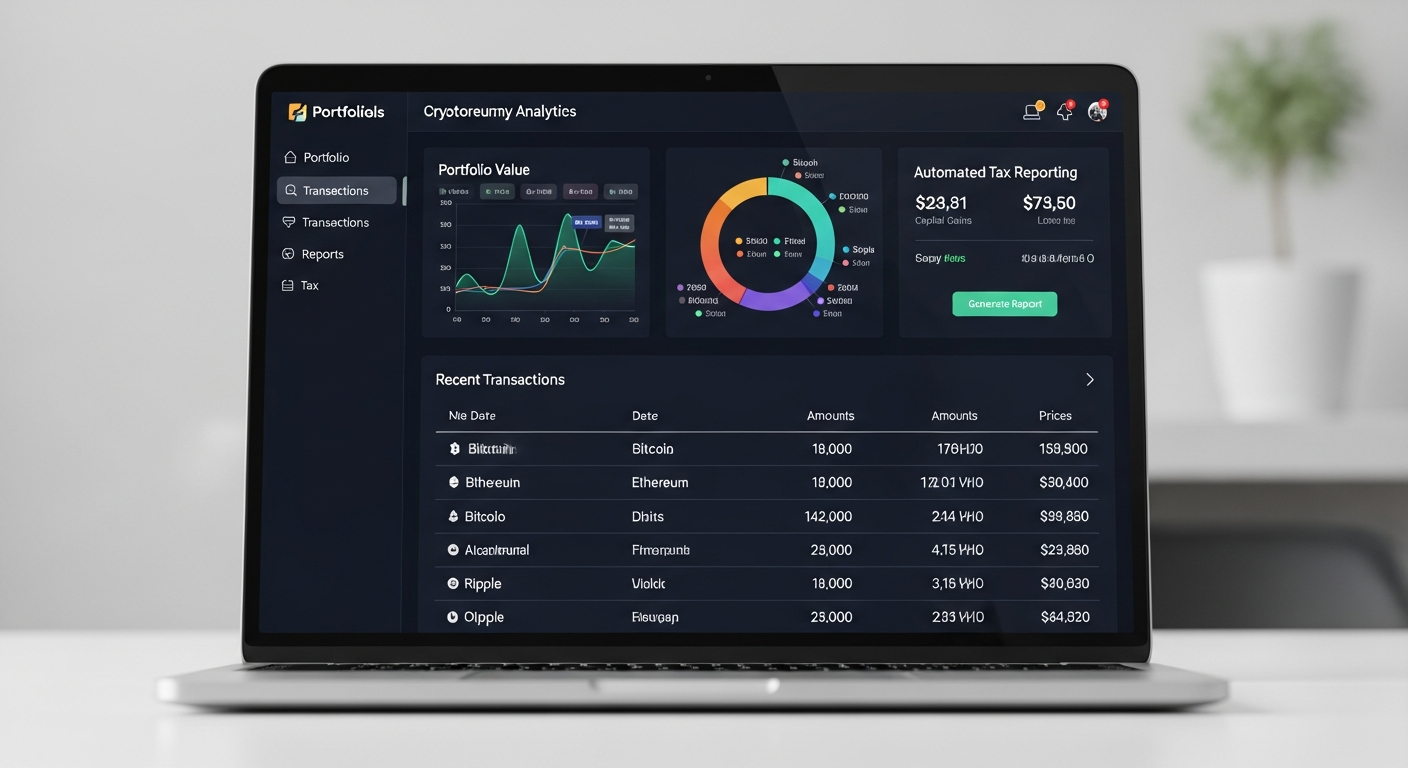
Attempting to calculate your crypto taxes manually with a spreadsheet is a recipe for disaster in 2026. The sheer volume of decimal places, fluctuating prices, and complex transfer histories makes human error inevitable. The ultimate weapon in any crypto tax guide usa is automation.
Dedicated crypto tax software syncs with your wallets and exchanges via API. It automatically pulls in your transaction history, calculates your cost basis, and identifies taxable events. Let us look at why investing in these tools is crucial.
Automating Your Tax Strategy
Crypto tax software does more than just generate forms at the end of the year. Modern 2026 platforms offer year-round portfolio tracking and tax-loss harvesting dashboards. These dashboards alert you to unrealized losses in your portfolio that you can sell to offset your capital gains.
Furthermore, these tools are constantly updated with the latest IRS regulations. When a new ruling regarding DeFi yields or NFT taxation drops, the software algorithms are adjusted automatically. This peace of mind is invaluable for active traders.
When choosing a software, ensure it supports the specific blockchains and exchanges you use. Not all tools can handle obscure Layer 2 networks or niche decentralized applications. Always test the integration capabilities before committing to a paid subscription.
Top Crypto Tax Software Comparison
There are several top-tier platforms available in 2026, including CoinTracker, Koinly, and TokenTax. Each has its strengths and weaknesses depending on your specific trading habits. Here is a general breakdown of what to expect from premium crypto tax tools.
✅ Pros of Premium Software
- Automatically generates Form 8949 and Schedule D
- Real-time tax-loss harvesting opportunities
- Seamless API integration with major exchanges and wallets
- Accurate cost basis tracking across multiple platforms
- Significantly reduces CPA billing hours
❌ Cons of Premium Software
- Can be expensive for high-volume traders
- Struggles with brand new or obscure DeFi protocols
- Requires granting API read-access to your accounts
- Manual reconciliation is still needed for missing data
[INTERNAL_LINKS]
7. Frequently Asked Questions (FAQ)
Even with a comprehensive guide, specific questions often arise regarding nuanced IRS rules. Below are the most common questions investors are asking during the 2026 tax season.
Do I have to pay taxes if I lost money in crypto?
No, you do not pay taxes on losses. In fact, losing money can be beneficial for your tax bill. Capital losses can be used to offset your capital gains. If your losses exceed your gains, you can deduct up to $3,000 of those losses against your ordinary income, and carry over the remainder to future tax years.
Can the IRS track my decentralized wallet?
Yes. While decentralized wallets do not require KYC (Know Your Customer) information, the blockchain is a public ledger. In 2026, the IRS uses advanced blockchain analytics firms to trace transactions from centralized exchanges (where you are KYC’d) to your decentralized wallets. Assuming anonymity on the blockchain is a massive compliance risk.
What happens if I fail to report my crypto taxes?
Failing to report crypto taxes is considered tax evasion. If caught, you will be liable for the back taxes owed, plus significant accuracy-related penalties (up to 20% of the underpayment) and accrued interest. In severe cases of willful evasion, the IRS can pursue criminal prosecution, leading to massive fines and potential jail time.
📚 You May Also Like