
Welcome to the definitive crypto tax guide for 2026, designed to help you navigate the increasingly complex world of digital asset reporting. If you traded, staked, or sold cryptocurrency this year, the IRS is watching closer than ever before. Understanding how to properly report your transactions is no longer optional; it is a critical component of your financial health.
Many investors feel overwhelmed by the sheer volume of their transactions and the ambiguity surrounding decentralized finance (DeFi) or non-fungible tokens (NFTs). However, failing to report your digital asset activity can lead to severe penalties, audits, and unnecessary stress. This comprehensive resource will break down everything you need to know to stay compliant and keep more of your hard-earned profits.
In this guide, we will explore the latest 2026 regulations, teach you how to calculate your capital gains accurately, and reveal advanced tax-saving strategies. Whether you are a casual holder or a high-volume day trader, mastering these principles will transform tax season from a nightmare into a streamlined process. Let us dive into the core mechanics of cryptocurrency taxation.
- 1. Core Principles of the Crypto Tax Guide for 2026
- 2. How to Calculate Your Crypto Capital Gains
- 3. Navigating DeFi, Staking, and Mining Taxes
- 4. Airdrops, Forks, and NFT Tax Rules Explained
- 5. Leveraging Crypto Tax Loss Harvesting
- 6. Best Crypto Tax Software Platforms for 2026
- 7. IRS Audit Triggers and Preparation Strategies
- 8. Frequently Asked Questions (FAQ)
1. Core Principles of the Crypto Tax Guide for 2026

The foundation of our crypto tax guide rests on how international tax agencies classify digital assets. In 2026, the IRS continues to treat cryptocurrency as property rather than fiat currency. This means that general tax principles applicable to property transactions, like stocks or real estate, apply to your crypto investments.
Because crypto is treated as property, every time you dispose of a coin, it triggers a potential tax consequence. You must track the fair market value of your assets at the exact moment of every transaction. This fundamental rule is the primary reason why crypto accounting can become complicated so quickly.
Understanding this property classification is your first step toward total compliance. It dictates how you report your holdings, how you calculate your profits, and which specific tax forms you need to file. Let us break down the specifics of how this applies to your daily transactions.
Understanding Cryptocurrency as Property
When the government labels crypto as property, it means you incur capital gains or losses upon its disposal. You are not taxed simply for holding a digital asset in a cold wallet. The tax liability only arises when an event of disposal takes place, locking in a gain or a loss.
For example, using Bitcoin to purchase a cup of coffee is legally viewed as selling that Bitcoin for cash, and then using that cash to buy the coffee. If the value of the Bitcoin increased between the time you bought it and the time you spent it, you owe tax on that difference. This micro-transaction reality surprises many new investors.
Furthermore, this property designation means you must file Form 8949 alongside your Schedule D for your annual returns. You are required to list the date acquired, date sold, proceeds, and cost basis for every single taxable event. Keeping meticulous records is the only way to satisfy these stringent reporting requirements.
Taxable vs. Non-Taxable Crypto Events
Not everything you do on a blockchain is a taxable event. Buying cryptocurrency with fiat currency (like USD) and simply holding it is completely tax-free. Transferring crypto between your own wallets or exchanges is also a non-taxable event, provided you maintain ownership of the assets.
Conversely, taxable events occur when you sell crypto for fiat money, trade one cryptocurrency for another, or use crypto to buy goods and services. Swapping Ethereum for a stablecoin like USDC is a taxable event, even though you did not cash out to your bank account. The IRS requires you to calculate the gain or loss on the Ethereum at the moment of the swap.
Receiving cryptocurrency as income, such as a salary, mining rewards, or staking payouts, is taxed differently. These instances are considered ordinary income rather than capital gains. You must report the fair market value of the coins on the day you received them as part of your gross income.
2. How to Calculate Your Crypto Capital Gains

Calculating your crypto capital gains is the most math-intensive part of the crypto tax guide. A capital gain or loss is simply the difference between what you paid for an asset and what you sold it for. If you sell an asset for more than your purchase price, you have a capital gain; if you sell it for less, you have a capital loss.
To perform this calculation accurately, you must know your cost basis, the sale proceeds, and the holding period. Subtracting the cost basis from your final proceeds reveals your exact taxable amount. While the formula is simple, applying it across thousands of micro-trades requires precision and specific accounting methods.
The IRS allows different accounting methods for determining which specific coins you sold, such as First-In-First-Out (FIFO) or Specific Identification (HIFO). Choosing the right accounting method can drastically alter your final tax bill. We will explore how these variables work together to determine your tax liability.
🛒 Ledger Nano X hardware wallet
View on Amazon →
As an Amazon Associate, we earn from qualifying purchases.
Determining Your Cost Basis Accurately
Your cost basis is the original value of your asset for tax purposes. It includes the purchase price of the cryptocurrency plus any transaction fees or commissions associated with the acquisition. Establishing an accurate cost basis is critical because a higher cost basis lowers your overall taxable capital gains.
If you purchased 1 BTC for $40,000 and paid a $200 exchange fee, your true cost basis is $40,200. When you later sell that Bitcoin for $60,000, you subtract $40,200, resulting in a taxable gain of $19,800. Accurate tracking of these fees is essential for legally minimizing your tax burden.
When you acquire cryptocurrency through alternative means, like a hard fork or an airdrop, your cost basis is usually the fair market value of the token upon receipt. If you are unable to prove your original cost basis due to lost records, the IRS may assume your cost basis is zero. This worst-case scenario means you would pay taxes on the entire sale amount, making record-keeping incredibly vital.
Short-Term vs. Long-Term Capital Gains Tax Rates
The length of time you hold a cryptocurrency directly impacts the tax rate you will pay. If you hold a digital asset for 365 days or less before disposing of it, any profits are considered short-term capital gains. Short-term gains are taxed at your ordinary income tax rate, which can range significantly depending on your total annual income.
If you hold the asset for more than one year (at least 366 days), you unlock the highly favorable long-term capital gains tax rates. For the 2026 tax year, long-term rates remain at 0%, 15%, or 20%, depending on your specific filing status and income bracket. Holding for the long term is one of the easiest and most effective strategies to lower your crypto taxes.
For example, a single filer in 2026 earning less than roughly $47,000 might pay 0% on long-term capital gains. However, a high earner could pay up to 20% on long-term gains, plus an additional 3.8% Net Investment Income Tax (NIIT). Understanding these thresholds allows you to time your sales strategically.
The Impact of Trading Fees on Your Taxes
Trading fees, gas fees, and transfer fees play a nuanced role in your crypto tax guide calculations. As mentioned earlier, fees paid to acquire an asset are added to your cost basis. Conversely, fees paid to sell or dispose of an asset are deducted from your total sales proceeds.
Network gas fees on blockchains like Ethereum can become astronomically high during bull markets. If you spend $50 in ETH gas to swap a token on a decentralized exchange, that $50 can be used to offset your gains. You must track these gas fees carefully, as they quickly add up and represent a significant tax deduction.
However, transfer fees paid simply to move crypto between your own wallets are generally not deductible as an investment expense under current 2026 tax law. Only fees directly tied to an acquisition or a disposition can alter your capital gains calculation. Be sure your crypto tax software is categorizing these different fee types correctly.
3. Navigating DeFi, Staking, and Mining Taxes

The explosive growth of decentralized finance has introduced immense complexity into the IRS cryptocurrency rules. Interacting with smart contracts, liquidity pools, and staking protocols creates a tangled web of taxable events. Traditional tax professionals often struggle to comprehend the mechanics of these cutting-edge financial instruments.
In 2026, the IRS has issued stricter guidance regarding how DeFi transactions must be reported. Earning yields, wrapping tokens, and receiving protocol emissions are generally viewed as taxable events. You cannot simply ignore these activities; they must be translated into standard income and capital gains frameworks.
Understanding DeFi taxes requires separating ordinary income from capital gains. Whenever you act as a node, provide liquidity, or lock up tokens for rewards, you are generating revenue that the government wants a piece of. Let us explore the specific tax treatments for staking, lending, and yield farming.
Reporting Income from Crypto Staking Rewards
Crypto staking allows you to earn rewards by participating in the validation of a proof-of-stake blockchain network. According to the latest 2026 IRS rulings, staking rewards are treated as ordinary income at their fair market value on the day you gain dominion and control over them. This means the moment the rewards hit your wallet and you can spend them, they become taxable income.
If you earn 5 SOL in staking rewards when the price is $100 per SOL, you must report $500 as ordinary income. This $500 also becomes the new cost basis for those specific 5 SOL tokens. If you later sell those tokens for $150 each, you will pay capital gains tax on the $50 profit per token.
It is important to note that if your staked tokens are locked in a protocol and you cannot access the rewards, the income is generally not recognized until the unlock period ends. You must track the exact daily value of your rewards, which is why utilizing automated tax tracking software is highly recommended for stakers.
📊 Statistical Insight: The Importance of Compliance
According to recent 2026 Treasury reports, over 45% of crypto investors still make basic reporting errors when filing their returns. Furthermore, IRS crypto compliance audits have increased by a staggering 312% since previous tax years, making accurate reporting more vital than ever.
The Complexities of DeFi Lending and Borrowing
Lending your cryptocurrency on decentralized platforms like Aave or Compound generates interest, which is fully taxable as ordinary income. Similar to staking, you must report the fair market value of the interest tokens you receive at the time of receipt. This applies even if you are paid in a platform-specific governance token.
Borrowing crypto, on the other hand, is not a taxable event. When you deposit collateral and take out a crypto loan, you are not selling your collateral, so no capital gains tax is triggered. This makes borrowing against your crypto a powerful strategy for accessing liquidity without creating a tax liability.
However, if your collateralized position is liquidated by the smart contract due to a market downturn, it is treated as a forced sale. You will incur a capital gain or loss based on the price at which the protocol liquidated your assets. Liquidations are fully taxable and must be reported on your Form 8949.
Tax Implications of Liquidity Pools and Yield Farming
Providing liquidity to decentralized exchanges (DEXs) like Uniswap is perhaps the most debated topic in DeFi taxes. When you deposit a pair of tokens into a liquidity pool (LP) and receive an LP token in return, the IRS generally views this as a crypto-to-crypto trade. This means depositing liquidity can immediately trigger a taxable capital gain on the tokens you deposited.
As you earn trading fees from the liquidity pool, those fees accumulate within the LP token’s value. When you eventually withdraw your liquidity by returning the LP token, you are executing another taxable trade. The difference between the value of your initial deposit and your final withdrawal constitutes your capital gain or loss.
Yield farming, where you stake your LP tokens in another smart contract to earn additional reward tokens, creates layers of ordinary income. Every time you harvest your yield farming rewards, you must report the USD value as ordinary income. The extreme frequency of these transactions makes yield farming a record-keeping nightmare without the right software.
4. Airdrops, Forks, and NFT Tax Rules Explained

Beyond traditional trading and DeFi, the crypto ecosystem is famous for surprising investors with free money and unique digital assets. Airdrops, hard forks, and Non-Fungible Tokens (NFTs) present unique challenges for tax reporting. The IRS has established specific guidelines to ensure these unique asset classes are taxed appropriately.
Many users mistakenly believe that because an airdrop was “free,” it is free from taxation. This is a dangerous misconception that can lead to significant audit risk. The government views newly created or distributed wealth as taxable income, regardless of whether you asked for it or not.
Similarly, the NFT boom has forced tax authorities to clarify how digital art and collectibles are treated. Depending on your involvement, NFTs can be taxed as property, collectibles, or even business inventory. Let us demystify the tax rules surrounding these popular crypto phenomena.
Managing Unexpected Crypto Airdrops and Hard Forks
When a blockchain undergoes a hard fork resulting in a new cryptocurrency, or when a protocol airdrops tokens directly into your wallet, you owe taxes. The IRS mandates that you report the fair market value of the new tokens as ordinary income. The taxable event occurs the moment you have the ability to transfer, sell, or exchange the assets.
For example, if you receive 1,000 new governance tokens via an airdrop, and they are trading at $2 each on the day you claim them, you have $2,000 of taxable ordinary income. This $2,000 also establishes your cost basis. If you hold them and sell them later for $3,000, you will owe capital gains tax on the $1,000 profit.
If you receive an airdrop of a scam token or a token with zero liquidity and zero market value, your recognized income is zero. You only owe tax if the asset has a provable, measurable fair market value. Always document the date, time, and exact price of airdropped tokens upon receipt to defend your calculations.
Buying, Selling, and Minting NFTs
For standard investors, buying and selling NFTs is treated the same as trading fungible cryptocurrencies. Purchasing an NFT with Ethereum is a taxable event, as you are disposing of your ETH. You must calculate the capital gain or loss on the ETH spent, and the purchase price becomes the cost basis for your new NFT.
When you eventually sell the NFT, you will calculate the capital gain or loss based on the sale price minus your cost basis. It is important to note that the IRS may classify certain high-end NFTs as “collectibles.” If an NFT is deemed a collectible, long-term capital gains are taxed at a maximum rate of 28%, which is higher than the standard 20% cap.
If you are an artist minting and selling your own NFTs, your tax situation is vastly different. The revenue you generate from initial sales and secondary market royalties is considered ordinary business income. You will likely need to file a Schedule C, pay self-employment taxes, but you can also deduct legitimate business expenses related to your NFT creation.
🛒 TurboTax Premier 2026 tax software
View on Amazon →
As an Amazon Associate, we earn from qualifying purchases.
5. Leveraging Crypto Tax Loss Harvesting

One of the most powerful tools in our crypto tax guide is a strategy known as tax loss harvesting. Because cryptocurrency markets are highly volatile, investors often hold assets that have significantly dropped in value. You can intentionally sell these losing assets to offset the gains you made on winning trades, thereby reducing your overall tax liability.
Tax loss harvesting is a completely legal and widely encouraged strategy used by savvy investors worldwide. By locking in your losses before the end of the 2026 tax year, you can dramatically shrink the amount you owe the IRS. It turns market downturns into valuable tax-saving opportunities.
To effectively utilize this strategy, you must continuously monitor your portfolio’s unrealized losses. Waiting until December 31st might be too late if the market suddenly rebounds. Let us examine how to implement this strategy and the specific rules you must follow.
How Tax Loss Harvesting Reduces Your Bill
The core mechanic of tax loss harvesting is netting your capital gains against your capital losses. If you have $10,000 in capital gains from selling Bitcoin, but you also sell an altcoin at a $6,000 loss, your net taxable gain is reduced to $4,000. This directly lowers the final amount of tax you will have to pay.
If your capital losses exceed your capital gains for the year, you can use the excess losses to offset your ordinary income. In 2026, the IRS allows you to deduct up to $3,000 of net capital losses against your regular income, such as your W-2 salary. This provides a direct reduction to your overall income tax bracket.
Any losses beyond that $3,000 limit are not wasted; they are carried forward into future tax years indefinitely. This means a massive loss in 2026 can be used to offset crypto gains in 2027, 2028, and beyond. Building a reservoir of carryover losses is a tremendous asset for future bull markets.
Avoiding the Wash Sale Rule in Crypto
In traditional stock markets, the IRS enforces the “wash sale rule.” This rule prevents investors from selling a stock for a loss and immediately buying it back within 30 days just to claim the tax deduction. If you violate the wash sale rule with stocks, your loss is disallowed for tax purposes.
However, as of the 2026 tax year, the wash sale rule still does not strictly apply to cryptocurrencies because they are classified as property, not securities. This loophole allows crypto investors to sell an asset for a loss, harvest the tax deduction, and buy the exact same asset back minutes later. This lets you maintain your market position while legally banking the tax write-off.
Despite this current loophole, legislation attempting to close the crypto wash sale gap is frequently debated in Congress. It is crucial to consult with a tax professional, as the IRS could introduce retroactive guidance or the economic substance doctrine could be applied if trades lack a genuine business purpose. Always stay updated on the absolute latest rulings.
6. Best Crypto Tax Software Platforms for 2026
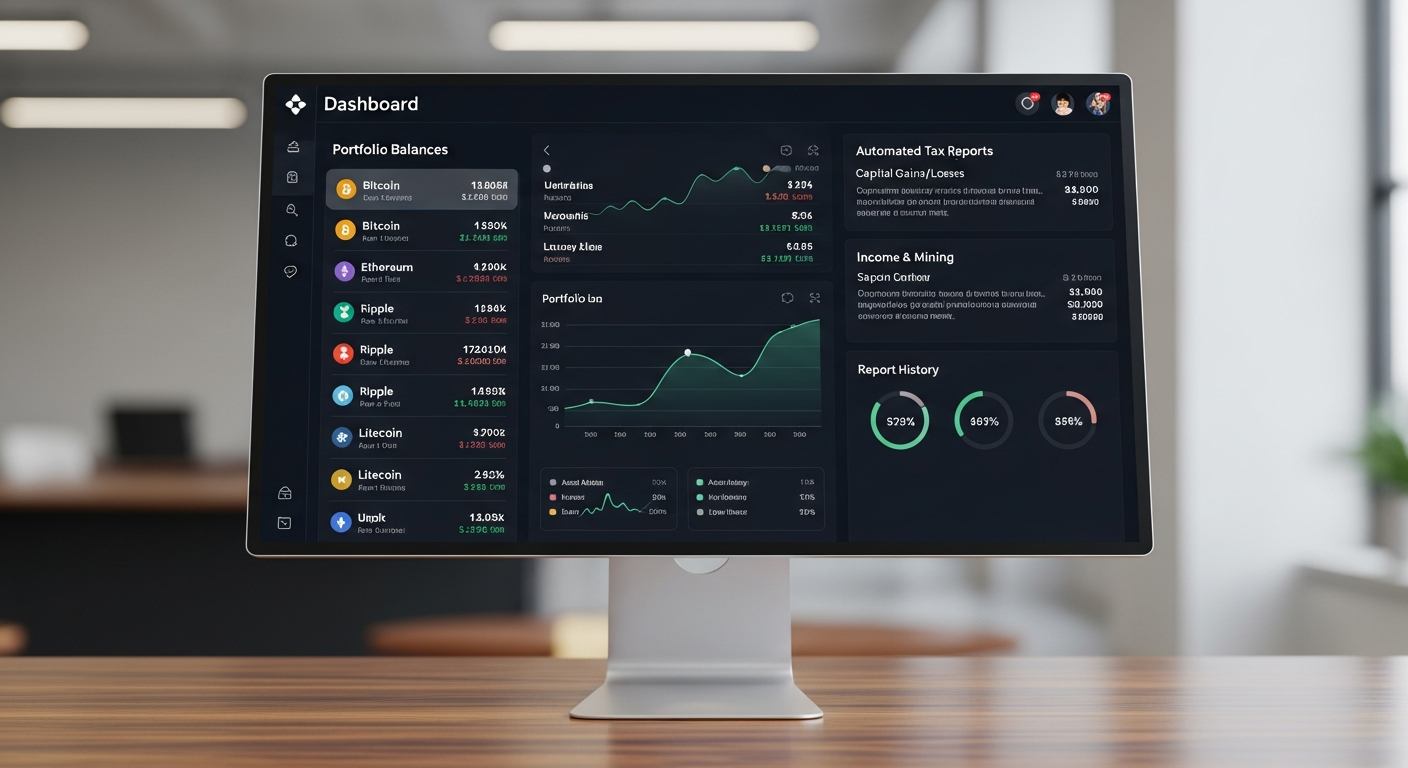
Attempting to manage your crypto tax guide calculations by hand is nearly impossible for anyone making more than a dozen trades a year. The complexity of cost basis tracking across multiple wallets, exchanges, and blockchains requires automated solutions. In 2026, leveraging dedicated crypto tax software is not a luxury; it is an absolute necessity.
These software platforms connect directly to your exchanges via read-only APIs and scan your public blockchain addresses. They automatically aggregate your transaction history, match transfers between your own wallets, and calculate your capital gains using approved IRS accounting methods. The end result is a pre-filled Form 8949 ready for your tax return.
Not all software is created equal, however. Some excel at centralized exchange reporting, while others are built specifically to handle complex DeFi smart contracts and NFT trades. Let us look at why manual tracking fails and compare the best tools available.
Why Manual Spreadsheet Tracking Usually Fails
Many beginners attempt to track their crypto transactions using Excel or Google Sheets. While this works for a few simple buys and sells, it quickly breaks down when you introduce transfers, staking, or gas fees. A single mathematical error in an early row will cascade downward, corrupting your entire cost basis history.
Furthermore, standard spreadsheets cannot automatically fetch the historical fair market value of a coin at a specific minute in time. When you execute a crypto-to-crypto trade, you must know the exact USD value of the asset at that very moment. Sourcing this historical price data manually is incredibly tedious and prone to human error.
Lastly, manual tracking makes tax loss harvesting practically impossible to execute in real-time. Automated software provides real-time dashboards showing exactly which assets are currently at a loss and ripe for harvesting. Switching to dedicated software saves hundreds of hours and ensures IRS compliance.
Comparing Top Crypto Tax Calculators
When selecting a crypto tax software in 2026, you must consider API integrations, DeFi support, and customer service. CoinTracker remains a dominant player due to its seamless integration with major exchanges like Coinbase and its user-friendly interface. It excels for traditional investors who stick to centralized platforms.
Koinly is another massive favorite, particularly praised for its international tax support and robust handling of obscure altcoins. It offers excellent error resolution tools that help you identify missing cost bases or broken API syncs. For heavy DeFi users, specialized tools like TokenTax or CoinLedger offer premium support for liquidity pooling and yield farming.
To help you decide, we have compiled a quick comparison of the top two platforms for the 2026 tax year. Choose the one that best fits your specific trading habits.
| Feature Comparison | CoinTracker | Koinly |
|---|---|---|
| Exchange API Integrations | Excellent (300+) | Excellent (400+) |
| DeFi & NFT Tracking | Good | Very Strong |
| Tax Loss Harvesting Dashboard | Included (Premium) | Included (Premium) |
| Best Suited For | Mainstream/Coinbase users | High-volume/DeFi traders |
✅ Pros of Using Tax Software
- Automates complex cost basis calculations instantly.
- Generates IRS Form 8949 automatically.
- Identifies real-time tax loss harvesting opportunities.
❌ Cons of Using Tax Software
- Premium tiers can be expensive for high-volume traders.
- Obscure DeFi protocols may still require manual CSV formatting.
- Requires giving read-only API access to your exchanges.
7. IRS Audit Triggers and Preparation Strategies

The final section of our crypto tax guide focuses on surviving an IRS audit. In 2026, the IRS has deployed advanced data analytics and artificial intelligence to cross-reference exchange reports with individual tax returns. They are actively hunting for discrepancies, making audits a tangible reality for non-compliant investors.
Understanding what triggers an audit allows you to proactively safeguard your return. The IRS receives Form 1099s directly from major crypto exchanges. If the numbers you report do not match the data the IRS already holds, a red flag is immediately raised in their system.
Preparation is your best defense against tax agency scrutiny. By maintaining pristine records and understanding the common pitfalls, you can navigate an audit smoothly and without penalties. Let us review the most common red flags and essential best practices.
Red Flags That Alert the IRS
The most glaring audit trigger is entirely ignoring the digital asset question on page one of Form 1040. In 2026, the IRS explicitly asks if you received, sold, or disposed of any digital assets. Answering “No” when an exchange has already sent the IRS a Form 1099 proving otherwise is a guaranteed way to trigger an investigation.
Another major red flag is reporting massive round numbers or wildly inaccurate cost bases. If you claim a $0 cost basis on a $500,000 transaction, or if your numbers look like estimates rather than exact calculations, the IRS algorithms will catch it. Precision down to the decimal point is required.
Finally, frequent large transfers to offshore exchanges or anonymous hardware wallets can attract scrutiny. While self-custody is legal and encouraged, moving large sums off centralized tracking systems often prompts the IRS to verify that those assets were not sold for unreported cash. Maintain a clear paper trail of all wallet-to-wallet transfers.
💡 Expert Insight
According to top tax attorneys specializing in 2026 crypto regulations, the IRS utilizes specialized blockchain forensics firms like Chainalysis to track decentralized transactions. You should assume that your public wallet addresses are already linked to your personal identity. Transparency and over-reporting are safer strategies than attempting to hide transactions on-chain.
Essential Record-Keeping Best Practices
The burden of proof in an audit falls entirely on the taxpayer. You must be able to prove your cost basis, the date of acquisition, and the date of sale for every transaction. To do this, download and securely store all CSV transaction histories from your exchanges at the end of every tax year.
Do not rely on exchanges to keep your data forever. Platforms go bankrupt, change their interfaces, or delete history past a certain number of years. Maintain your own encrypted backups of all API data, wallet addresses, and software calculation reports.
If you use multiple wallets, keep a simple master list of all your public addresses and the purpose of each wallet. If the IRS questions a transfer, handing them a clean, organized map of your digital asset ecosystem demonstrates compliance and usually resolves inquiries rapidly. Organization is the ultimate shield against IRS penalties.
[INTERNAL_LINKS]
8. Frequently Asked Questions (FAQ)
Do I have to pay taxes if I just hold my crypto?
No, simply buying and holding cryptocurrency is not a taxable event. The IRS views crypto as property, meaning you only incur a tax liability when you dispose of the asset (sell, trade, or spend it). If your portfolio value increases by 1,000% but you never sell, you owe zero taxes on those unrealized gains for the 2026 tax year.
How does the IRS know about my cryptocurrency trades?
Major cryptocurrency exchanges operating in the US (like Coinbase or Kraken) are required to report user activity to the IRS using Form 1099-DA and other reporting structures updated for 2026. If you receive a 1099 from an exchange, the IRS already has a copy of it. Furthermore, the IRS uses advanced blockchain analytics tools to track public ledger transactions back to known exchange accounts.
What happens if I forget to report my crypto taxes?
Failing to report your cryptocurrency transactions can result in severe consequences, including failure-to-pay penalties, accuracy-related fines, and accumulating interest on the unpaid amount. In extreme cases of intentional tax evasion, it can lead to criminal charges. If you realize you made a mistake in previous years, it is highly recommended to work with a tax professional to file an amended return proactively.
📚 You May Also Like